A web designer's quote lands in your inbox. It lists 20 suburb pages, monthly "local SEO" and a promise to get you to the top of Google Maps. You can't tell which parts would bring in calls, and which you'd keep paying for without seeing any work.
This post covers what to ask for, what to skip, and when you don't need a custom site at all. It's for the sole trader with one van and for the firm with a crew and an office. We read every rule and price below on the regulator's or provider's own page on 21 October 2026.
Does a tradie need a website?
Not always. If word of mouth already fills your diary, a Google Business Profile and one simple page can do the job. A site can be nothing flash and still make you look like a business.
A site of your own earns its cost in three cases. You want enquiries to come straight to you. You're chasing bigger jobs, where customers check you out before they call. Or you want your name, photos and reviews under your control, off someone else's platform.
Here are the ready-made options, with the price each provider shows on its own page.
| Option | Cost on its own page | Fits when |
|---|---|---|
| Google Business Profile | Free to set up | Most work is word of mouth and you want to show on Maps with reviews |
| Tradify Instant Website | $19 a month on top of a Tradify subscription (GST not stated) | You already run jobs in Tradify and want one simple page |
| hipages | From $139 + GST a month | You need work now and can reply to leads fast |
| ServiceSeeking | From $129 a month including GST, for most members | You want a monthly plan instead of a fee on each job |
| Airtasker | 12.5% to 20% of each task price, with tax added to the fee | Small one-off jobs, where you pay the fee only on tasks you win |
Google's Business Profile page says listing your business on Google is free. The other prices come from Tradify's Instant Website page, hipages' membership costs, ServiceSeeking's price update and Airtasker's service fee page. Tradify says you need its subscription to publish the page. Prices change, so check each page before you sign up.
If you're weighing up a website builder against a developer, our post on Wix, Squarespace or a developer compares what each one costs.
Does my licence number have to be on my website?
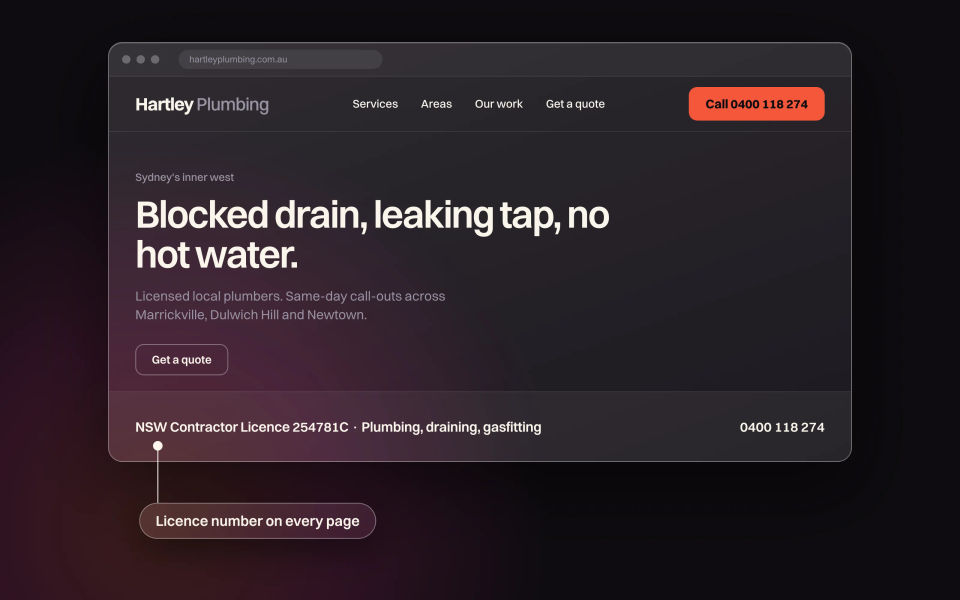
In NSW and Queensland, the regulator's current page says your licence number goes in your ads. Queensland names websites outright, and the NSW rules cover internet ads. WA and SA have said the same for builders, and we couldn't confirm Victoria.
NSW. The NSW Government page on building trade advertisements (read 21 October 2026) lists three things ads must show. They are the licensee's name, the licence number with the correct category of work, and a business phone number.
The rules apply to internet advertising, which we read as including your website. Electricians, plumbers, drainers, gasfitters and air-con and refrigeration techs need a current licence to advertise work of any value. The page also says you can't show a price that's only part of the cost unless the full price is clearly shown too. If your site shows a call-out fee, we'd show the full price beside it.
Queensland. The QBCC's advertising page (read 21 October 2026) asks for the name you're licensed under and your licence number. Your ad must also say you're licensed under the QBCC Act. The page counts websites, Facebook pages and directories such as hipages and ServiceSeeking as ads. The QBCC doesn't license trading names, and it says an ad with only a trading name will most likely be non-compliant. The details must be easy to read and reasonably prominent. If you're not licensed, the QBCC says your ads must state the value of work you can do without a licence.
Western Australia. A 2013 WA Government industry bulletin (read 21 October 2026) says a building service contractor's ads must contain its registration number. That bulletin covers builders, painters and building surveyors.
South Australia. Consumer and Business Services has said building work contractors must publish their name and licence number in ads. That's from a 2015 media release, read 21 October 2026.
Victoria. We couldn't confirm the current rule on an official page. The Building and Plumbing Commission handles builder and plumber registration, so check its site or call it.
Rules differ by state and licence class. Check yours with your regulator, then ask for the number in the footer of every page.
What should be on the site so people call?
Ask for these five things:
- Your phone number on every screen, so one tap on a mobile starts the call.
- Each service you do, in the words your customers use.
- The areas you cover, in plain words on one page.
- Real photos of your own jobs, with no stock images.
- Genuine reviews, with any connection to you stated.
On photos, Google's photo guidelines for Business Profiles (read 21 October 2026) say a photo should be in focus and well lit. Google also says "the image should represent reality". Those are good rules for your website too. A customer worried about dodgy tradies wants to see work you've done.
On reviews, the ACCC (read 21 October 2026) says fake or misleading reviews are against the law. Reviews by family, staff or paid people need that connection stated. It's also against the law to remove genuine negative reviews. Google's local ranking page (read 21 October 2026) says more reviews and positive ratings can help your ranking. So ask for a review when a job goes well, and reply to the poor ones.
What should the quote form ask?
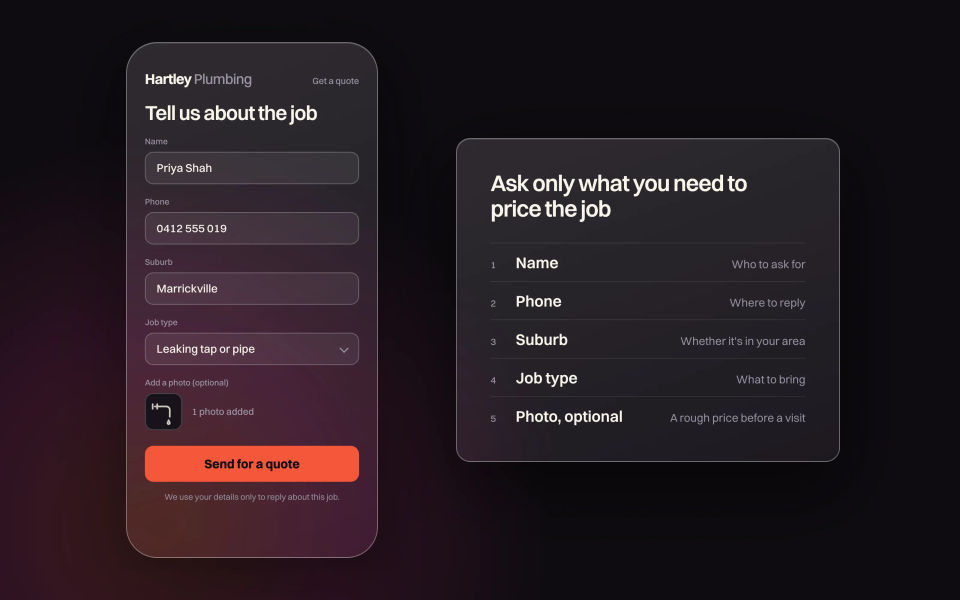
Ask only what you need to price the job. Name, phone, suburb, the type of job and an optional photo are usually enough. A photo of the leak or the cracked tiles can help you give a rough price before a visit.
A form collects personal information, so ask about privacy early. The OAIC (read 21 October 2026) defines a small business as one with annual turnover of $3 million or less. Many small businesses fall outside the Privacy Act. The OAIC lists some that are covered whatever their turnover, such as health service providers and businesses that trade in personal information.
Either way, the OAIC recommends you "protect any personal information you hold". So ask the person building your site where form entries go, who can read them and how long they're kept. A short privacy note beside the form tells customers the same.
Do I need a page for every suburb?
Usually not. Some quotes include a page for every suburb, each with the same text and a different suburb name.
Google's spam policies (updated 28 August 2026, read 21 October 2026) describe "doorway abuse". One case it lists is "pages targeted at specific regions or cities that funnel users to one page". A pack of near-copies with swapped suburb names fits that description. A suburb page with photos and details of real jobs there has something of its own to say.
For showing up on Maps, the place to list your areas is your Google Business Profile. Google's service-area page (read 21 October 2026) says you can have up to 20 service areas. The whole area shouldn't be more than about 2 hours' drive from your base. If customers don't come to your address, Google says to remove it from the profile.
Google's profile guidelines (read 21 October 2026) also say there should be one profile per business. A second profile for another suburb breaks that rule.
Not sure what yours needs?
Tell us what your business does. We will suggest what is worth building first and put it in a written quote.
Tell us about your businessWhat should I question in a quote?
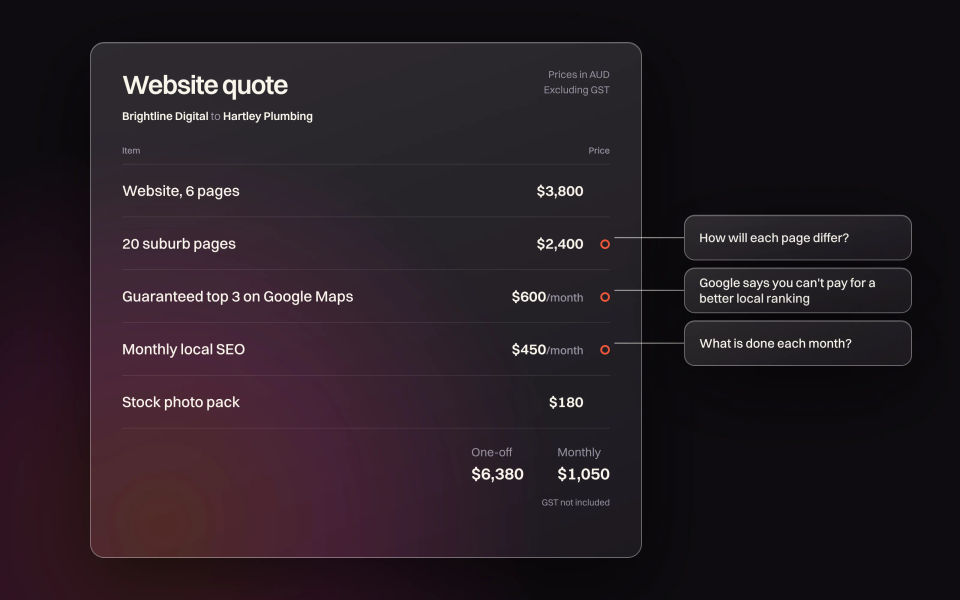
Four things deserve a direct question before you sign.
- A paid map ranking. Google's local ranking page says you can't pay for a better local ranking. It says your prominence takes in how many websites link to you and how many reviews you have.
- A suburb pack. Ask how each page will differ, and what real jobs it will show.
- A monthly fee with no stated work. Ask what is done each month, and how you'll see it.
- Stock photos. Ask whether the photos will be yours, and who takes them.
Our post on comparing website quotes shows how to line two quotes up on the same five things. For what changes the price, see what a website costs in Australia.
When is a lead platform the better buy?
A lead platform is a site such as hipages that sells you job enquiries. It suits a new business, an empty diary, or a move to a new area. It suits you best if you can price and reply fast.
hipages lists lead plans from $139 + GST a month on its membership costs page (read 21 October 2026). New members join on a 6-month introductory term, which renews on a 12-month term. "Every lead is capped at 3 businesses", and the credits a lead costs vary. The page shows no dollar price per lead.
ServiceSeeking says its memberships start at $129 a month including GST for most members. Its help page (read 21 October 2026) says it doesn't charge commission. Airtasker's service fee runs from 12.5% to 20% of the task price, with tax added to the fee. Both come from the pages linked in the table above.
A site of your own suits work you want under your own name. That means repeat customers, referrals and bigger jobs where people check you out first. You can also run both. In Queensland, the QBCC counts your platform profile as an ad, so your licence number goes there too.
What this looks like for two trade businesses
The checklist is easier to picture on real jobs. Here are two trade businesses of different sizes, and what was built for each.
Hartley Plumbing, a two-van plumber in Sydney's inner west
The problem. Most work came by word of mouth and Facebook messages. Messages often arrived without a suburb or a photo, so each one needed a call back before a price.
What was built. A six-page site: a home page, one page per main service, an areas page and a quote form. The licence number and phone sit in the footer of every page. The form asks for the five things above and takes one photo.
How it works day to day. A form entry lands in the shared inbox with the photo attached. Whoever is free replies with a rough price or books a visit. When a service changes, the owner edits that page's words and photos without calling anyone.
For similar work, see how we build websites for trade businesses.
Calder Electrical, an electrical contractor with a small team in Brisbane
The problem. The electricians measured up on site, then typed quotes at night back at the office. Prices drifted between staff, and some quotes went out days after the visit.
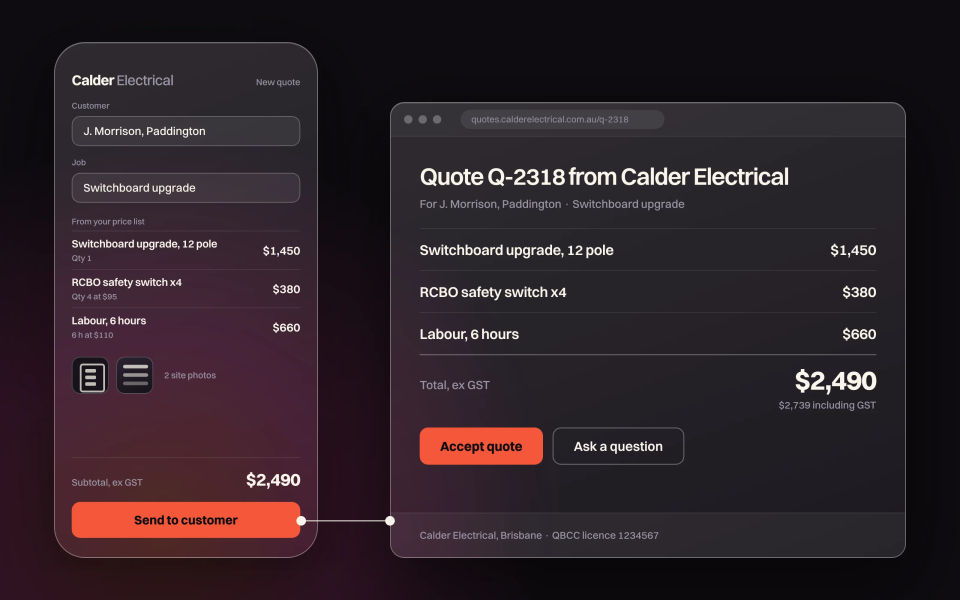
What was built. A small quote tool that runs on the team's phones. It pulls lines from a saved price list, adds site photos and sends the customer a link. From that page the customer can accept the quote or ask a question.
How it works day to day. The electrician builds the quote before leaving the job. Every quote uses the same price list, and the office can see what has been sent and accepted. The licence number shows on the customer's quote page too.
For similar work, see our quote and job tools for teams.
What should I ask the person building it?
Ask these five questions, and get the answers in writing:
- Will the domain be registered in my business's name? Our post on who owns a website domain shows how to check.
- Who owns the site, the words and the photos when it's finished?
- What does the monthly fee pay for, item by item?
- Can I change my services and photos myself?
- Will my licence number and phone number be on every page?
Some trade businesses want more than a website, such as a tool for the crew. Our showcase project for a building company is a field app with photo checklists and customer sign-off on the phone.
Your next step
Check your licence class with your regulator first. Then decide whether a Google profile and one simple page would cover you for now. If you want a site of your own, take the five questions to everyone who quotes. You can see how we build websites on our websites page.
This is general information, not legal advice.
Common questions
Does a tradie need a website?
Not always. If word of mouth fills your diary, a Google Business Profile and one simple page can be enough. A site of your own helps when you want enquiries to come straight to you and you're chasing bigger jobs.
Do I have to put my licence number on my website?
In NSW and Queensland, the regulators' own pages say your licence number goes in your advertising, and that covers online ads. Queensland's QBCC names websites, Facebook pages and directories such as hipages. WA's regulator said in 2013 that builders, painters and building surveyors must put their registration number in ads. SA's regulator said the same of building work contractors in 2015. Check the rule for your own licence class with your regulator.
Do I need a page for every suburb I work in?
Usually not. Google's spam policies describe pages targeted at cities or regions that funnel visitors to one page as doorway abuse. For Maps, Google lets a service-area business list up to 20 service areas on its Business Profile.
How much does hipages cost?
On 21 October 2026, hipages listed lead plans from $139 plus GST a month. New members join on a 6-month introductory term that then renews on a 12-month term. Each lead goes to up to 3 businesses, and the credits a lead costs vary.